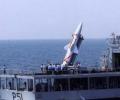
India on Thursday successfully test-fired its nuclear-capable Dhanush ballistic missile with a strike range of 350 km
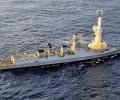
The BrahMos supersonic cruise missile is the world's fastest operational system in its class and recently the DRDO has extended the range of the missile system from the existing 298 km to around 450 km.

Must Watch: Agni 5 launch; Veena gets Dirty

The procurement will come at a cost of Rs 38,900 crore.

India on Monday successfully test-fired its nuclear-capable Agni-II missile intermediate range ballistic missile, with a range of 2000 kms, from the Wheelers Island off Orissa coast.
The missile, weighing 650kg, can carry a 50kg payload over a distance of 25km.
It was the naval version of Prithvi, which has a range of 250 to 300 km.

Agni-V is a three stage missile, 17 metres tall, two metres wide and capable of carrying 1.5 tonne of nuclear warheads.
India will join the elite club of nations having ICBM with the Defence Research and Development Organisation planning to carry out the launch of over 5,000 km-range Agni-5 missile in April.

India on Friday successfully test-fired its indigenously-developed nuclear-capable Prithvi-II and Dhanush ballistic missiles in separate trials, boosting the armed forces' operational readiness.

The missiles were randomly chosen from the production stock and the entire launch activities were carried out by the specially formed strategic force command and monitored by the scientists of Defence Research and Development Organisation as part of training exercise, a defence scientist said.
Surface-to-surface Agni V missile is launched from the Wheeler Island off Odisha coast on Thursday
India on Thursday successfully test-fired the Agni-5 Inter-Continental Ballistic Missile, which was developed by the Defence Research and Development Organisation.The missile was test-fired from Wheeler Island in Odisha at 8.05 am.
India's long-criticised Akash anti-aircraft missile is now blazing towards success. After years of rejection from the military, the Akash is being accepted as a world-class missile.
Lakshya is the indigenously developed Pilotless Target Aircraft.
The indigenously built multi-target missile has a range of 25km and is one of the five missiles under various stages of development by the DRDO.
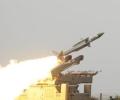
India today successfully test fired indigenously-developed surface-to-air Akash missile with a strike range of 25 km and capability to carry warhead of 60 kg from the Integrated Test Range at Chandipur as part of a user-trial.
DRDO scientists, who conducted the test, described it as a user's trial.
Astra is an indigenously developed air-to-air missile.
For the second time in a month, the Block II version of the supersonic BrahMos cruise missile with a striking range of 290 km, successfully hit its target during a test at the Pokhran firing range on Sunday. After today's test, officials said the development phase of the Block II version of the missile was over and it was ready for induction in the Army. They said the mission objectives of the test had been completely fulfilled.

BrahMos Aerospace, an India-Russia joint venture, produces the supersonic cruise missile that can be launched from submarines, ships, aircraft, or from land platforms.

India has tested a 1,000 kg indigenously-developed glide bomb, which successfully hit a target 100 km away, in the Bay of Bengal off the Odisha coast, making the country self-reliant in guided precision bombs.
Defence Minister Pranab Mukherjee has ruled out any move to convert the short range surface-to-surface Prithvi missile into an anti-missile or a nuclear shield.
Prithvi has already been inducted into the Army and Wednesday's test involved one of the products picked up at random from the assembly line.
The supersonic anti-ship cruise missile was jointly developed by India and Russia.
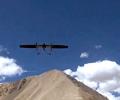
When the armoured vehicles arrive in this 'kill zone', each PALM 400 picks out its target and fires an armour-penetrating projectile, penetrating it from the top where its armour protection is the least.
The sophisticated multi-target missile was test fired from a mobile launcher at about 1230 IST.

The development and trials will continue and the rocket is expected to enter service any time now.

Indian Army has deployed Pinaka and Smerch Multiple Rocket Launcher Systems (MRLS) at forward position near the China border to counter any threat arising across on the Line of Actual Control (LAC).

Striking the airfield's runway precisely with one bomb is more economical than using traditional free-fall bombs.
The sleek 3.8 metre high missile has a striking range of 25 to 40 km.
India on Sunday successfully test-fired a new interceptor missile capable of neutralising any incoming long-range missile at higher altitude.

India on Monday successfully test-fired its indigenously developed nuclear capable Prithvi-II missile, which has a strike range of 350 km, as part of a user trial for the defence forces.
After failing to hit the target in the previous test, the Defence Research and Development Organisation is planning to test-fire the Block II version of the BrahMos supersonic cruise missile on March 4."We are planning to conduct the second test of the BrahMos Block II version at the Army's test range in Pokharan on March 4 this week," Defence Ministry officials said.

Defence Minister Manohar Parrikar on Wednesday said there was no controversy in the sacking of Avinash Chander as Defence Research and Development Organisation chief and it was he who recommended that the position should be held by someone from a "slightly younger generation" and not by someone on contract.

The missile has a strike range of more than 2,000 km.
The MRSAM is amongst the most lethal surface-to-air missiles in service anywhere.

Their success or failure will eventually hinge on how much equipment the services procure, and whether the finance ministry supplements the allocations in the Budget
 © 2026 Rediff.com - Advertise with us - Disclaimer - Privacy Policy - Sitemap - Feedback - About us - Terms of use - Grievances